Two Tastes, One Home: How Couples Can Stop Fighting Over Furniture and Start Decorating Together

You fell in love with a person. You didn't necessarily fall in love with their sectional sofa, their gallery wall of vintage travel posters, or their inexplicable loyalty to anything that looks like it belongs in an English hunting lodge. And yet, here you are — sharing a zip code, a lease, and a very loaded opinion about throw pillows.
Welcome to one of the most quietly stressful parts of cohabitation: figuring out whose taste wins.
Spoiler: nobody has to win. And honestly, the homes that feel the most alive are rarely the ones that followed one rigid vision. They're the ones that carry a little tension — a little push and pull — between two different people who both care about where they live. The trick is learning how to navigate that tension without turning a trip to the furniture store into couples therapy.
First, Name the Problem Without Blaming the Person
Before you can find middle ground, you have to be honest about what you're actually disagreeing on. Is it color? Scale? Era? Function versus form? Sometimes what feels like a full-blown style clash is actually just one specific conflict — like the fact that your partner wants a giant L-shaped sectional and you're convinced it'll eat the living room alive.
Try sitting down together and each writing a list of three non-negotiables. Not a wishlist — actual deal-breakers. Things that, if they ended up in your home, would genuinely bother you every single day. Keep those lists short and honest. Then compare them.
You might find there's way less overlap than you expected. Most couples aren't fighting about everything — they're fighting about a handful of flashpoint pieces or choices that carry a lot of emotional weight. Knowing exactly where the friction lives makes it a lot easier to work around it.
Divide the Territory (Seriously, It Works)
One of the most underused strategies in shared-space decorating is zoning — giving each person genuine ownership over certain areas of the home. This isn't about drawing a line down the middle of the living room. It's about being intentional with who gets creative control where.
Maybe one partner has full say over the home office or a reading nook. The other gets to run point on the bedroom aesthetic. Common areas like the living room or kitchen become collaborative territory where both of you have to agree before anything gets purchased.
This approach works because it respects autonomy. When you know you have a space that's truly yours — where your taste gets to breathe without negotiation — you tend to be a lot more flexible everywhere else. It takes the pressure off every single decision feeling like a referendum on whose style matters more.
Find the Overlap in the Middle
Here's something most design-conflicted couples don't realize: even wildly different styles usually share some common ground. A person who loves mid-century modern and a person who loves rustic farmhouse both tend to appreciate natural materials, warm tones, and furniture that feels substantial rather than flimsy. A maximalist and a minimalist might both be drawn to quality craftsmanship and meaningful objects — they just differ on quantity.
Spend some time looking at spaces together — not to argue about them, but to notice what you both respond to positively. Scroll through a design account together and just say "yes" or "no" to images without explaining yourself at first. After a while, patterns emerge. You start to see what you actually share.
That overlap is your decorating foundation. Build from there and layer your individual preferences on top.
Let the Big Pieces Be Neutral, the Small Pieces Be Personal
A practical framework that works really well for style-mismatched couples: invest in neutral anchor pieces for the big stuff, and let personality come through in the smaller, easier-to-swap details.
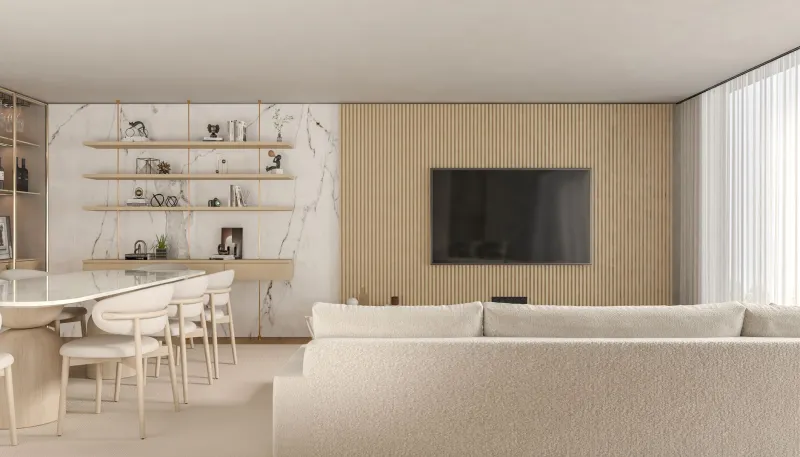
A sofa in a warm greige, a dining table in natural oak, a bed frame in a simple upholstered silhouette — these are pieces that don't scream any one aesthetic. They're a canvas. From there, you each get to add your flavor through throw blankets, artwork, lamps, plants, ceramics, and accent furniture.
The beauty of this approach is that it's also practical from a budget standpoint. Smaller décor items are much easier to rotate, replace, or move to a different room as your tastes evolve. You're not locked in. And because neither of you is fully seeing your exact vision reflected back at you, the space starts to feel like something you genuinely built together — which is kind of the whole point.
Stop Thinking of It as a Compromise. Start Thinking of It as a Collaboration.
Compromise sounds like loss. You give up something; they give up something; nobody's happy. Collaboration sounds like something you made together that's better than what either of you would've done alone.
The reframe matters more than it sounds. When you approach shared decorating as a creative project rather than a negotiation, you're more likely to stay curious and open instead of defensive. You might discover that your partner's insistence on warmer lighting makes the whole apartment feel cozier. They might realize that your push for less clutter actually makes the pieces they love stand out more.
Some of the most interesting, personality-filled homes in design history came from exactly this kind of creative friction. Two distinct points of view, pressed together, tend to produce something more textured and surprising than a single vision executed perfectly.
When You're Truly Stuck, Bring in a Tiebreaker
Sometimes you've done all the right things and you're still staring at each other across a furniture showroom floor with zero consensus. That's okay. That's what interior designers are for.
A good designer isn't there to pick sides — they're there to translate both of your visions into something that actually works in the space. Many offer one-time consultations that are surprisingly affordable, and having a neutral third party say "here's why this works and this doesn't" can take a lot of the emotional charge out of the conversation.
Alternatively, lean on tools like room planning apps or mood board platforms. Sometimes seeing your ideas rendered in a shared visual space makes it easier to evaluate them on their own merits rather than through the lens of whose idea it was.
Your Home Should Feel Like Both of You Live There
At the end of the day, a shared home that only reflects one person's taste isn't really a shared home — it's just someone's apartment that another person happens to sleep in. That's not a great foundation for feeling comfortable, settled, or genuinely at home.
The goal isn't a perfect showroom. It's a space where both of you walk in at the end of the day and feel like you actually belong there. Where something catches your eye that you love, and something else catches theirs. Where the whole thing, somehow, feels like you.
That kind of home is worth the occasional disagreement about throw pillows. Promise.