Why Your Home Feels Overwhelming Even When It Looks Great
The Room That Looks Perfect but Feels Wrong
Imagine scrolling through a beautifully styled interior on Pinterest. Every piece is gorgeous. The palette is cohesive. The lighting is warm. And yet, if you were to actually live in that space, you might find yourself feeling vaguely tense without knowing why.
This is one of the more confusing experiences in home design — the disconnect between a space that looks beautiful and one that actually feels good to be in. And it's more common than you'd think.
The culprit, more often than not, isn't the furniture itself. It's the relationship between the furniture and the empty space around it.
What Science Says About Space and Stress
Environmental psychology has spent decades studying how physical spaces affect human mood, cognitive function, and stress levels. The findings are pretty consistent: clutter and visual density are directly linked to elevated cortisol levels — the hormone your body produces when it's under stress.
A landmark study from the University of California, Los Angeles found that women who described their homes as cluttered or unfinished showed higher levels of cortisol throughout the day compared to those who described their homes as restful or restorative. The mere perception of disorder was enough to keep the stress response running in the background, like a program you forgot to close.
The interesting part? This applies even when the space is filled with things you love. A room packed with beautiful objects can still trigger that low-grade overwhelm if the visual load is too high. Your brain doesn't distinguish between clutter you hate and clutter you adore — it just registers the density.
The Invisible Architecture of Empty Space
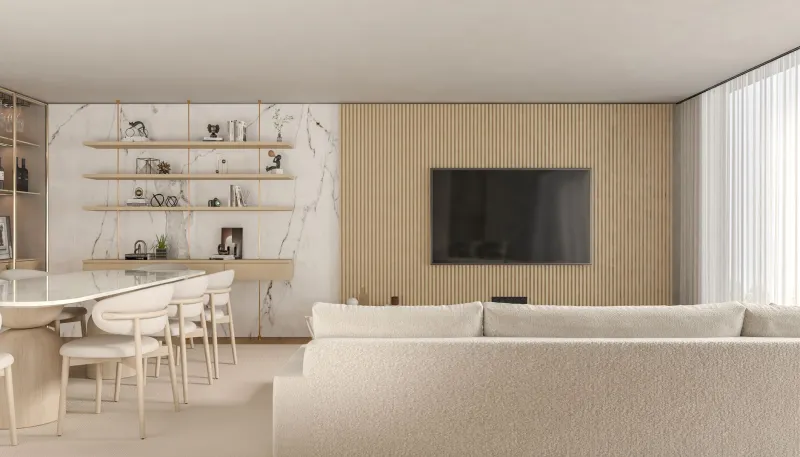
In design, negative space refers to the intentional empty areas around and between objects. It's a concept borrowed from visual art, and it's just as powerful in three-dimensional living spaces.
Think of negative space as breathing room for your eyes. When you walk into a room, your gaze moves through the space, landing on focal points and then resting in the quiet areas between them. If there are no quiet areas — if every surface is filled, every corner is occupied, every wall has something on it — your eyes never get to rest. And neither does your brain.
This is why some minimalist spaces feel almost meditative, even when they're not particularly warm or cozy. The emptiness itself is doing emotional work.
But you don't have to go full minimalist to benefit from this principle. You just have to be intentional about where the breathing room is.
Density vs. Fullness: There's a Difference
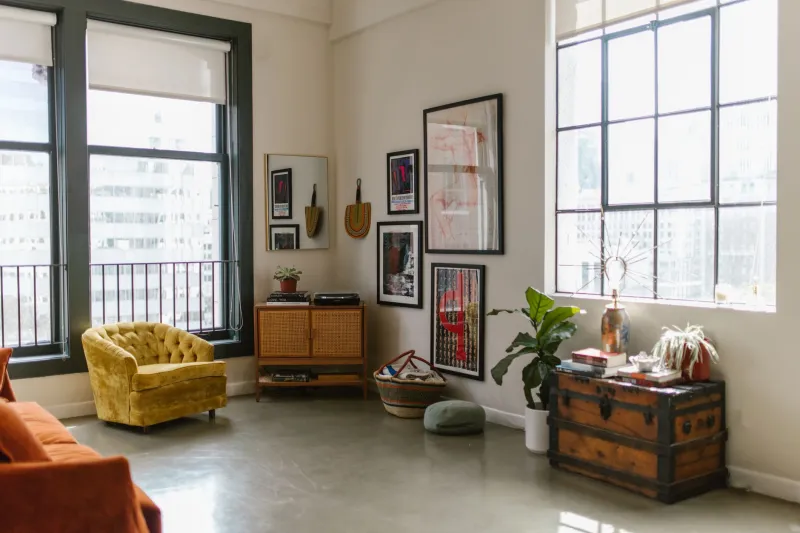
A room can feel full without feeling dense, and that distinction matters. Fullness is about warmth, personality, and the sense that a space is genuinely lived in. Density is what happens when fullness tips past a certain threshold and becomes visual noise.
Some signs your space has crossed from full to dense:
- You feel a subtle reluctance to spend time in a room you otherwise like
- Your eyes don't know where to land when you walk in
- Cleaning the space feels disproportionately exhausting
- Guests tend to cluster in one area rather than moving through the room naturally
- You notice yourself feeling more relaxed in hotel rooms or other people's homes
None of these are dramatic red flags on their own, but if several of them resonate, your layout might be working against your nervous system.
The Furniture Arrangement Factor
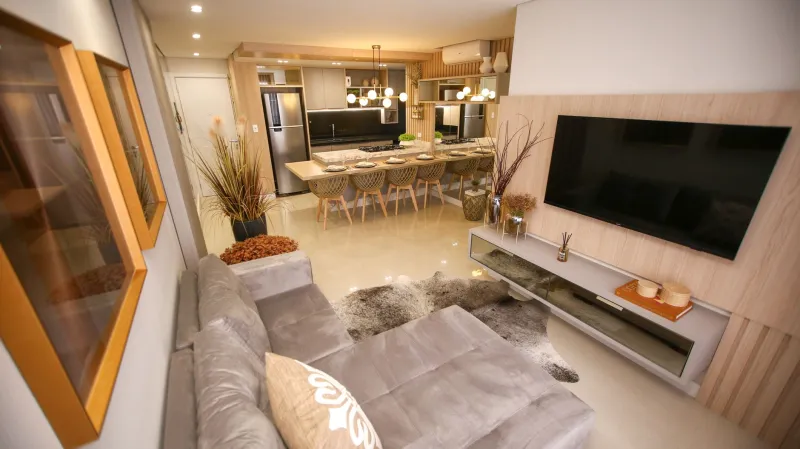
It's not just about how much stuff you have — it's also about how it's positioned. Furniture that blocks natural pathways, sits too close together, or faces inward without any visual release can make even a spacious room feel claustrophobic.
A few principles that tend to open up a space:
Honor the traffic flow. Every room has natural paths people take to move through it. When furniture interrupts those paths — even subtly — it creates friction that registers as stress. Walk through your room the way you normally would and notice where you have to adjust your body. Those are your problem zones.
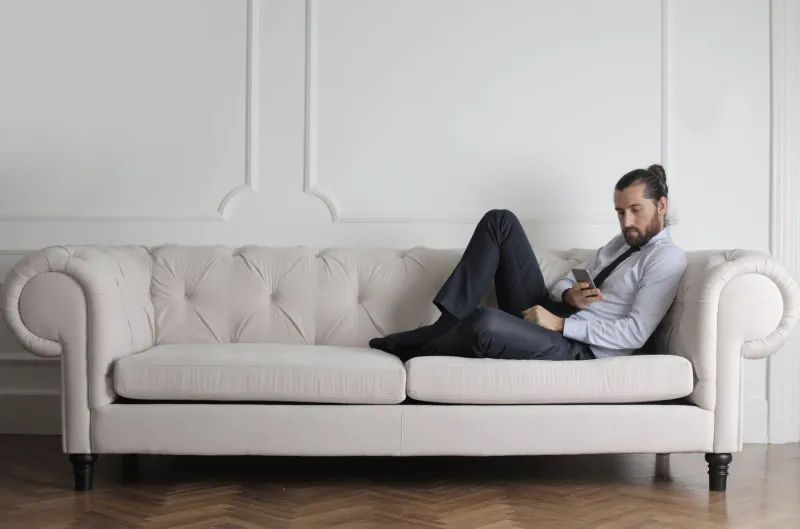
Give your largest pieces room to breathe. Your sofa, bed, or dining table should have at least 18–24 inches of clear space around them. This isn't just a safety guideline — it's what allows those pieces to exist as visual anchors rather than obstacles.
Leave one wall or corner intentionally empty. This is counterintuitive for people who love design, but a bare wall or an unoccupied corner gives the rest of the room somewhere to expand toward. It's the visual equivalent of a deep breath.
Vary the visual weight throughout the room. Clustering all your heavy, dark, or visually complex pieces in one area creates a kind of gravitational pull that feels unbalanced. Spreading lighter and heavier elements around the room gives the eye a more comfortable journey.
A Simple Way to Evaluate Your Own Space
Stand in the doorway of the room you spend the most time in. Take a slow look around without trying to analyze anything. Notice your first emotional response — not what you think about the space, but what you feel.
Then ask yourself: where does my eye rest comfortably? Where does it feel stuck or overwhelmed? Is there anywhere in this room that feels genuinely quiet?
If you can't find a restful focal point — a clear surface, an open stretch of floor, a wall that isn't asking anything of you — that's your starting point.
You don't have to get rid of things you love. Sometimes it's as simple as moving a piece to another room, clearing a single shelf, or pulling a chair away from the wall to create a little breathing room behind it.
Living Beautifully Means Living Comfortably
At House of Living, we believe your home should do more than look good in photos. It should actually feel good to be in — every morning when you wake up, every evening when you decompress, and every weekend when you finally have time to just exist in your space.
The most beautiful homes aren't the ones with the most in them. They're the ones where everything has been chosen and placed with enough intention that the space itself feels like it's on your side. That's not minimalism — it's just living with awareness. And it makes all the difference.