Before You Share a Closet, Have This Conversation About Furniture

Moving in together is one of those milestones that sounds purely romantic until you're standing in a living room surrounded by two mismatched coffee tables, arguing about which one stays. Suddenly, the question isn't just where are we living — it's how are we living, and what does that even look like when two completely different people bring two completely different homes into one space?
The good news: most of these headaches are avoidable. Not with a spreadsheet (well, maybe a small one), but with a real conversation — the kind that happens before the lease is signed and the U-Haul is booked.
Start With the Feeling, Not the Furniture
Here's where most couples go wrong. They start by talking about things — who's keeping the couch, whose kitchen table wins — before they've ever talked about the feeling they want their shared home to have.
Try this instead: ask each other what a home means to you. Is it a place to decompress after a long day, or do you want it to feel energized and social? Does one of you picture a calm, minimal space while the other imagines warmth, color, and texture everywhere? These aren't trick questions. They're the foundation.
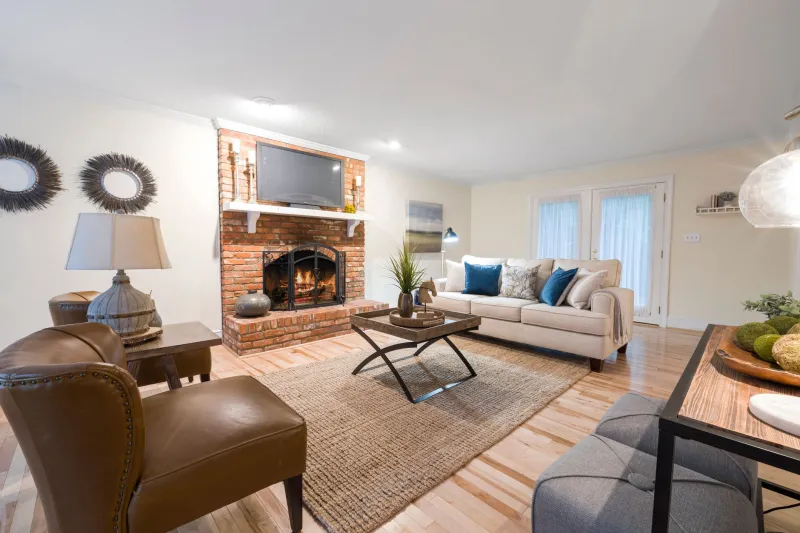
Once you both understand what kind of atmosphere you're going for, individual furniture decisions get a whole lot easier. That oversized velvet armchair your partner loves? It might actually work in a warm, layered space. That sleek minimalist dining table you've been attached to? It might need to go into storage if you're building something cozier together.
Get Honest About Your Non-Negotiables (and Your Actual Reasons)
Everyone has one. That one piece of furniture that feels non-negotiable — the piece you'd genuinely feel sad to get rid of. Maybe it's a hand-me-down from a grandparent. Maybe it's the first real piece of furniture you ever bought for yourself. Maybe it's just really, really comfortable and you're not giving it up.
Before combining households, each person should identify their true non-negotiables — and be honest about why. There's a difference between "I love this bookshelf because it's genuinely beautiful and functional" and "I love this bookshelf because getting rid of it feels like erasing a chapter of my life." Both are valid. But knowing which one you're dealing with helps.
Once you've each named your must-keeps, lay them out side by side. Can they coexist? Do they clash? Are there too many of them to realistically fit in one home? This is where compromise starts — not with resentment, but with clarity.
Talk Budget Before You Talk Taste
Design conversations can get derailed fast when two people have wildly different ideas about what things should cost. One partner might think $800 for a dining chair is completely reasonable. The other might think that's a full month's grocery budget. Neither is wrong — but if you don't talk about it upfront, you'll run into friction every single time a purchase comes up.
Sit down and figure out a few things together:
- What's your shared budget for furnishing the new space? Not just what you each have individually, but what you're willing to spend together on the home.
- Are there areas where you're both willing to invest more? A lot of couples agree to spend more on the sofa and bed because they use them constantly, and less on decorative pieces they can swap out over time.
- What's your approach to getting there? Some people want everything done and styled in month one. Others are fine building slowly and living with empty corners for a while. Knowing this upfront saves a lot of tension.
There's no right answer here — just the one that actually works for both of you.
Do a Stuff Audit Together
Before you start planning what to buy, figure out what you already have. Walk through each other's spaces — in person if possible, or via a video call if you're not in the same city yet — and take stock of what exists.
Ask yourselves:
- What pieces are genuinely good quality and worth keeping?
- What's worn out, outdated, or just not something either of you loves?
- What duplicates exist (two bed frames, two sets of pots and pans, two TVs) and which version is actually better?
This audit often reveals that you have more to work with than you think — and it surfaces potential conflicts early, when there's still time to make thoughtful decisions instead of rushed ones on moving day.
Design by Room, Not by Person
One trap couples fall into is dividing the home by ownership rather than by vision. "The living room is your territory, the bedroom is mine." It sounds fair, but it tends to produce a home that feels like two separate apartments sharing a front door.
Instead, approach each room as a shared project. Pick one room to start with — usually the living room, since it's the most communal — and design it together from scratch. What pieces from each of you could work in here? What might need to be stored or donated? What gaps exist that you'll need to fill?
This process takes longer, but it produces a space that genuinely feels like both of you — which is the whole point.
Give Yourself Permission to Let Things Go
This one's harder than it sounds. Furniture carries memory. That futon from your first apartment, the lamp you found at a flea market in college, the side table your mom helped you paint — these things mean something. Letting go of them can feel like losing a piece of yourself.
But here's the thing: the best version of your shared home probably can't be built entirely out of two separate histories. Some things need to go to make room for what comes next. And that's okay. It doesn't mean the past didn't matter. It means you're building something new.
If a piece has real sentimental value but doesn't fit the space, consider whether it could live somewhere else — a guest room, a home office, a family member's place. Letting something go from the living room isn't the same as letting it go forever.
The Conversation Is Ongoing
Here's the part nobody tells you: this isn't a one-time talk. Your home will evolve. Your tastes will shift. A piece you both loved in year one might feel wrong by year three. Budget changes. Life changes. The furniture conversation is something you'll keep having — and that's actually a good thing.
The couples who build homes they genuinely love together aren't the ones who got it perfect on the first try. They're the ones who stayed curious about each other's vision, kept communicating, and treated their shared space as something worth tending to — not just once, but continuously.
So before the boxes are packed and the truck is loaded, make time for the conversation. Not the logistics — the real one. The one about what home means to each of you, and what you want it to feel like together.
That's the conversation that changes everything.